
Is GST Difficult to Learn?
Understanding GST:
GST (Goods and Services Tax) is an indirect tax that replaces multiple taxes such as VAT, Service Tax, and Excise Duty. It is governed by the GST Council and administered by the Central Board of Indirect Taxes and Customs under the Ministry of Finance.
GST is designed to simplify the taxation structure by creating a unified tax system across India. It applies to the supply of goods and services and is collected at every stage of value addition.
The entire GST compliance system operates digitally through the Goods and Services Tax Network portal.
Because it is online and compliance-driven, many beginners assume GST is complicated. In reality, GST follows a logical structure that becomes clear once you understand the fundamentals.
Why Do People Think GST Is Difficult?
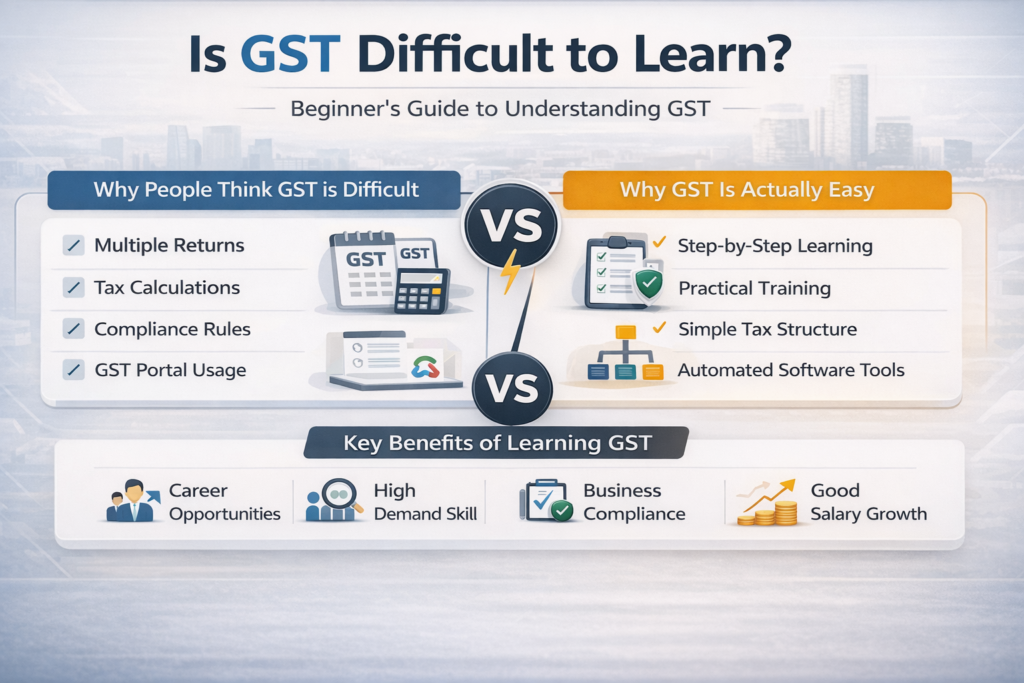
There are several reasons why GST appears challenging to beginners.
1. Multiple Tax Types
GST includes:
- CGST (Central GST)
- SGST (State GST)
- IGST (Integrated GST)
At first, understanding when to apply each type can feel confusing. However, once you understand the difference between intra-state and inter-state transactions, the concept becomes simple.
2. Various Return Forms
GST involves filing different returns such as:
- GSTR-1 (Sales return)
- GSTR-3B (Monthly summary return)
- GSTR-9 (Annual return)
Beginners may feel overwhelmed by these forms. But when taught step-by-step, each form has a clear purpose and structured format.
3. Input Tax Credit (ITC)
Input Tax Credit reconciliation is one of the most discussed topics in GST. Matching purchase records with supplier data can seem technical. However, once you understand how ITC works — tax paid on purchases can be claimed against tax payable on sales — the logic becomes straightforward.
4. Compliance Deadlines
GST requires regular compliance. Monthly and annual filings may appear stressful to newcomers. However, with proper training and calendar management, deadlines become routine.
5. Online Portal Navigation
Since GST filing happens through the government portal, beginners sometimes fear technical errors. With guided practice sessions, portal usage becomes easy.
Is GST Really Difficult? The Reality
GST is not difficult — it is systematic.
Most people struggle initially because they:
- Start with advanced topics without understanding basics
- Do not practice live return filing
- Try to memorize instead of understanding logic
- Lack accounting foundation
When GST is learned in the correct sequence — fundamentals → registration → invoicing → returns → reconciliation — it becomes manageable.
Who Finds GST Easy to Learn?
Certain groups may find GST easier due to their background.
Commerce Students
Students who have studied accounting and taxation concepts already understand:
- Debit and credit
- Sales and purchase entries
- Financial statements
This makes GST learning smoother.
Accountants
Working accountants already handle invoices and bookkeeping. For them, GST is an extension of existing responsibilities.
CA Aspirants
Chartered Accountancy students study indirect taxation as part of their curriculum, making GST familiar territory.
Business Owners
Entrepreneurs who manage billing and taxation gain practical understanding quickly.
Can Non-Commerce Students Learn GST?
Yes, absolutely.
Non-commerce students can learn GST successfully if they first understand:
- Basic accounting principles
- How invoices work
- Simple tax calculations
Many successful GST professionals today come from non-commerce backgrounds but invested time in learning fundamentals.
Step-by-Step Method to Learn GST Easily
If you want to ensure GST does not feel difficult, follow this structured approach:
Step 1: Learn GST Basics
Start with:
- What is GST?
- Why was GST introduced?
- Types of GST
- Tax slabs
Do not jump directly into return filing.
Step 2: Understand Invoicing
Learn how to:
- Create GST-compliant invoices
- Calculate tax rates
- Separate taxable and non-taxable supplies
Invoicing clarity reduces confusion later.
Step 3: Practice GST Registration
Understand:
- Who needs GST registration
- Threshold limits
- Registration process
Step 4: Learn GSTR-1 Filing
Focus on:
- Sales data entry
- B2B and B2C transactions
- Credit notes
Step 5: Learn GSTR-3B Filing
Understand:
- Tax liability calculation
- ITC claim
- Payment process
Step 6: Practice ITC Reconciliation
Learn how to match purchase records with supplier filings.
Step 7: Understand Annual Returns
Study GSTR-9 filing basics.
Following this sequence prevents confusion.
How Long Does It Take to Learn GST?
The time required depends on dedication and practice.
- Basic understanding: 2–3 weeks
- Practical filing confidence: 1–2 months
- Advanced compliance: 2–3 months
With consistent practice, most learners gain working proficiency within 90 days.
Common Mistakes Beginners Make
To avoid difficulty, do not:
- Ignore accounting basics
- Skip practical training
- Avoid reconciliation practice
- Depend only on theory
- Ignore GST updates
GST laws evolve, so staying updated is important.
Is GST Hard Compared to Other Courses?
Compared to:
- Chartered Accountancy
- Company Secretary
- CMA
GST is much simpler.
It is a skill-based course, not a multi-year academic qualification. It focuses on practical application rather than theoretical depth.
Career Benefits of Learning GST
Understanding GST offers excellent career opportunities.
Job Roles
- GST Executive
- Tax Assistant
- Accounts Executive
- Compliance Officer
- GST Practitioner
Industries Hiring GST Professionals
- Manufacturing companies
- IT firms
- Retail chains
- E-commerce companies
- CA firms
Since GST compliance is mandatory, demand remains stable.
Salary After Learning GST
Entry-level GST professionals earn:
₹15,000 – ₹25,000 per month
With 3–5 years of experience:
₹30,000 – ₹50,000 per month
Senior-level professionals and consultants earn:
₹60,000+ per month
Freelancers managing multiple clients can earn more.
Why GST Is a Future-Proof Skill
GST is a nationwide taxation system. As long as businesses operate, GST compliance will remain mandatory. This ensures:
- Stable demand
- Continuous job opportunities
- Long-term career growth
Unlike some technical skills that become outdated, taxation knowledge remains relevant.
Challenges in Learning GST (And How to Overcome Them)
Challenge 1: ITC Reconciliation
Solution: Practice real case studies.
Challenge 2: Portal Errors
Solution: Hands-on training sessions.
Challenge 3: Amendment Updates
Solution: Follow GST Council notifications.
Challenge 4: Handling Notices
Solution: Learn compliance response formats.
Is GST Difficult for Business Owners?
For business owners, GST becomes easier when they understand:
- Invoice structure
- Tax rates
- Filing frequency
Many entrepreneurs learn GST to reduce dependency on third-party accountants.
FAQ's
No, GST is not difficult to learn if you start with the basics. Understanding GST concepts such as tax structure, invoicing, and return filing step-by-step makes the subject easy for beginners. With practical training and regular practice, most learners can understand GST within a few weeks.
The time required to learn GST depends on the depth of training. Basic GST concepts can be learned in 2–3 weeks, while practical GST return filing and compliance training may take 1–3 months.
GST can be learned by:
- Commerce students
- B.Com and M.Com graduates
- MBA (Finance) students
- Accountants
- Business owners
- Entrepreneurs
- Anyone interested in taxation and accounting
Even non-commerce students can learn GST with basic accounting knowledge.
Basic accounting knowledge is helpful but not mandatory. Many GST courses begin with accounting fundamentals, which makes it easier for beginners to understand taxation concepts.
A typical GST course covers topics such as:
- Introduction to GST
- Types of GST (CGST, SGST, IGST)
- GST registration process
- GST invoicing
- Input Tax Credit (ITC)
- GST return filing (GSTR-1, GSTR-3B, GSTR-9)
- GST reconciliation
E-way bill generation
Yes, GST is a good career option because every registered business must comply with GST regulations. Skilled GST professionals are required in accounting firms, corporate companies, and tax consultancies.
Entry-level GST professionals typically earn between ₹15,000 and ₹25,000 per month. With experience, salaries can increase to ₹40,000–₹60,000 per month or more depending on expertise and industry.
Yes, after gaining proper knowledge and practical experience, you can start your own GST consultancy or work as a freelance tax consultant helping businesses file GST returns.
Yes, GST knowledge helps business owners understand tax compliance, avoid penalties, and manage financial records more efficiently.
No, GST is generally easier compared to advanced professional courses like Chartered Accountancy or CMA. With structured learning and practical exposure, most learners can understand GST concepts without difficulty.
Practical vs Theoretical Learning
GST is best learned through:
- Live portal practice
- Real invoice entry
- Reconciliation exercises
- Case studies
Pure theoretical study may make it feel complicated.
Final Verdict: Is GST Difficult?
GST is not inherently difficult.
It may appear complex initially due to:
- Technical terms
- Multiple forms
- Compliance rules
However, when learned step-by-step with practical exposure, GST becomes logical and manageable.
With 2–3 months of structured training and regular practice, most learners gain confidence in filing GST returns independently.
Conclusion
GST is not a difficult subject — it is a structured taxation system that requires understanding and practice. Whether you are a commerce student, working professional, entrepreneur, or career switcher, GST can be learned successfully with the right guidance.
Instead of fearing its complexity, approach GST systematically:
- Start with basics
- Practice regularly
- Focus on real-life application
- Stay updated with amendments
Learning GST not only builds technical competence but also opens doors to stable career opportunities, professional growth, and financial independence.
If you commit to consistent learning, GST will transform from a confusing subject into a valuable professional skill.