
Table of Contents
ToggleSyllabus of Tally Course
Important Modules Covered in Tally Training
The syllabus of Tally course gives learners a clear understanding of the accounting, inventory, taxation, payroll and practical Tally Prime topics covered during training.
Choosing a Tally course becomes easier when you know exactly what you are going to study. Some learners only look for basic accounting entries, while others want a broader understanding of inventory, taxation, payroll, banking and business reporting.
A detailed Tally course syllabus helps learners move from simple accounting concepts to more specialized features step by step.
The Tally training curriculum at Accounting Masters includes 23 learning modules. It begins with manual accounting and basic software knowledge and gradually introduces practical areas such as vouchers, GST, inventory, payroll, job costing, banking and data security.
This article gives you a clear overview of the topics included in the syllabus.
Syllabus of Tally Course: 23 Modules at a Glance
The syllabus of Tally course at Accounting Masters covers the core areas learners need to understand TallyPrime for accounting and business-related work. The modules move from basic accounting concepts and voucher entries to inventory, GST, payroll, banking and other practical features.
Here are the major modules included in the curriculum:
| No. | Module |
|---|---|
| 1 | Manual Accounts & Tally Introduction |
| 2 | Company & Ledger Creation |
| 3 | Transactions, Vouchers & Entry Passing |
| 4 | Adjustment Entries |
| 5 | Reports in Tally |
| 6 | Bills of Exchange & Interest Calculations |
| 7 | Inventory Management |
| 8 | Expiry of Stock & Batch Management |
| 9 | Price List & Point of Sale |
| 10 | Tracking Numbers |
| 11 | Bills of Material |
| 12 | Cost Centres |
| 13 | Payroll |
| 14 | GST |
| 15 | TDS & TCS |
| 16 | Job Costing |
| 17 | Bank Reconciliation Statement |
| 18 | Budgets & Controls |
| 19 | Multicurrency |
| 20 | Post-Dated Vouchers |
| 21 | Scenarios in Tally |
| 22 | Data Management & Security Controls |
| 23 | Resume Preparation, Interview Questions & Job Support |
Now, let’s understand what each part of the syllabus involves.
1. Manual Accounts and Introduction to Tally
The learning journey starts with the foundation of accounting.
Before working with accounting software, learners need to understand how financial transactions are recorded manually. This makes it easier to understand what happens behind each entry in Tally, which is widely used by businesses to record and manage financial transactions. The introductory section may include:
- Basic accounting terms
- Debit and credit concepts
- Journal entries
- Ledger posting
- Trial Balance
- Double-entry system
- Introduction to computerised accounting
Once these basics are clear, learners can begin exploring the Tally environment and its functions.
2. Company and Ledger Creation
Every business maintains its own financial records. In Tally, this process begins with setting up the company and creating the required accounting masters.
This module helps learners understand how to:
- Create a company
- Configure basic settings
- Create account groups
- Create individual ledgers
- Organise financial information
For instance, instead of recording all expenses under one heading, a business can maintain separate accounts for rent, electricity, salaries and other expenses.
Proper setup makes future transaction recording easier and more organised.
3. Transactions, Vouchers and Entry Passing
This module focuses on the actual recording of day-to-day business activities.
Different transactions require different voucher types. Learners are introduced to common entries involving:
- Payments
- Receipts
- Cash transfers
- Journal adjustments
- Purchases
- Sales
A practical exercise might involve recording a purchase made on credit, followed by the payment made to the supplier later.
Such exercises help students understand the complete flow of a transaction.
4. Adjustment Entries
Not every accounting entry happens immediately when money changes hands.
Certain expenses and incomes need adjustments at the end of an accounting period. This section introduces learners to situations involving:
- Expenses still payable
- Expenses paid in advance
- Depreciation
- Provisions
- Closing adjustments
These entries help ensure that financial statements reflect the appropriate accounting period.
5. Reports in Tally
After entering transactions, the next step is understanding the information produced from those records.
This module introduces important reports that help users review financial performance and account balances.
Learners may work with:
- Trial Balance
- Profit and Loss Account
- Balance Sheet
- Ledger reports
- Group summaries
The purpose is not simply to generate a report but also to understand what the figures represent.
6. Bills of Exchange and Interest Calculations
Businesses sometimes enter into credit arrangements that require formal tracking.
This module introduces the accounting treatment of bills and related calculations.
Topics can include:
- Bills receivable
- Bills payable
- Due dates
- Settlement of bills
- Interest calculations
These concepts are useful when transactions involve agreed payment periods rather than immediate settlement.
7. Inventory Management
Accounting records show the financial side of a business, while inventory features help track the goods handled by that business.
This section covers the organisation and management of stock.
Topics may include:
- Stock groups
- Stock items
- Units of measurement
- Warehouses or godowns
- Stock movement
- Stock valuation
For example, a retailer selling several categories of products can maintain separate stock information for each item.
8. Expiry of Stock and Batch Management
Certain industries need more detailed stock tracking.
Products such as medicines or food items may require businesses to monitor batches and expiry information.
This module introduces concepts related to:
- Batch-wise stock
- Manufacturing information
- Expiry details
- Batch tracking
- Product identification
These features make inventory management more suitable for businesses with specialised stock requirements.
9. Price List and Point of Sale
A business may not always sell every product at one fixed price.
Different customers, locations or sales situations can require different pricing arrangements.
This module introduces:
- Price lists
- Pricing structures
- Customer-specific pricing
- Point of Sale transactions
- Sales billing
Learners gain an understanding of how pricing and sales activities can be managed within the system.
10. Tracking Numbers
Tracking numbers can help connect related documents and transactions.
This feature may be used to follow the movement of goods or transactions through different stages.
The module helps learners understand document tracking related to:
- Orders
- Delivery
- Purchase processes
- Sales processes
- Related references
This can improve clarity when several transactions are connected to one another.
11. Bills of Material
Bills of Material are particularly useful in manufacturing or production activities.
A finished product may require several raw materials. The BOM feature helps define those requirements.
Learners may understand:
- Raw material requirements
- Finished goods
- Production relationships
- Material consumption
- Manufacturing-related records
For example, a manufacturer can identify the materials required to produce one finished item.
12. Cost Centres
Businesses sometimes want to analyse expenses beyond the regular ledger level.
A company may want to know how much a particular department, project or activity costs.
Cost centres help organise information for such analysis.
This module can cover:
- Department-wise expenses
- Project-based tracking
- Cost allocation
- Income allocation
- Cost analysis
This gives users another way to examine business performance.
13. Payroll
Payroll deals with employee-related financial information.
This part of the syllabus introduces the basic process of organising salary and employee records.
Topics can include:
- Employee information
- Salary components
- Pay heads
- Attendance details
- Payroll processing
- Payslips
Payroll knowledge can be useful for understanding how employee-related financial records are managed systematically.
14. GST
GST is an important subject for accounting learners in India.
The Tally course syllabus includes practical exposure to GST-related accounting processes.
Learners may study:
- GST configuration
- Tax-related ledgers
- Purchase transactions
- Sales transactions
- Input and output tax concepts
- GST-related reports
Since tax laws and procedures can change, current compliance work should always be checked against official sources.
15. TDS and TCS
This module introduces TDS and TCS features in the context of accounting transactions.
The learning process may include:
- Basic setup
- Transaction-related treatment
- Deduction or collection entries
- Party configuration
- Relevant reports
Learners should understand the software process while also keeping up with current statutory requirements.
16. Job Costing
Some organisations need to measure the cost and financial performance of individual assignments.
Job costing helps separate financial information according to a specific project or job.
This module may include:
- Project-related expenses
- Cost allocation
- Job-wise income
- Material usage
- Financial analysis
This approach can help businesses review the financial results of individual assignments.
17. Bank Reconciliation Statement
The balance shown in business records may sometimes differ from the balance appearing in the bank statement.
Bank reconciliation helps identify and examine such differences.
Learners may practise:
- Recording banking transactions
- Reviewing bank statements
- Identifying unmatched entries
- Recording bank charges
- Accounting for interest
- Reconciling transactions
This is a useful practical process for maintaining accurate banking records.
18. Budgets and Controls
Planning is an important part of business management.
Budgets allow businesses to set expected financial targets and later compare those expectations with actual results.
This module introduces:
- Budget preparation
- Financial targets
- Monitoring actual performance
- Budget comparisons
- Basic controls
It helps learners understand how accounting information can also support planning.
19. Multicurrency
Businesses dealing with international transactions may need to record information in currencies other than Indian Rupees.
This module introduces the basic handling of:
- Foreign currencies
- Exchange rates
- Currency conversion
- Foreign currency transactions
- Exchange differences
It gives learners exposure to accounting situations involving international business activity.
20. Post-Dated Vouchers
Some business transactions are connected with a future date.
Post-dated vouchers help manage transactions that are scheduled for later processing.
Topics may include:
- Future-dated payments
- Post-dated cheques
- Scheduled receipts
- Pending transactions
This helps users understand the importance of timing in transaction management.
21. Scenarios in Tally
Businesses sometimes need to examine possible financial outcomes before finalising them.
Scenario-related features can help users work with provisional information separately.
This module introduces concepts related to:
- Optional entries
- Provisional transactions
- Alternative financial views
- Scenario-based information
It provides learners with an introduction to analysing possible financial situations
22. Data Management and Security Controls
Accounting data contains important financial information, so proper management and protection are essential.
This section focuses on maintaining and controlling company data.
Topics may include:
- User access
- Password protection
- Data backup
- Data restoration
- Importing information
- Exporting information
- Company data management
- Security controls
Learners also understand why access to financial records should be properly managed.
23. Resume Preparation, Interview Questions and Job Support
The final module focuses on helping learners prepare to present their knowledge professionally.
This section includes areas such as:
- Resume preparation
- Common interview questions
- Tally-related interview preparation
- Career guidance
- Job-related support
The purpose is to help learners prepare for the next stage after completing their training.
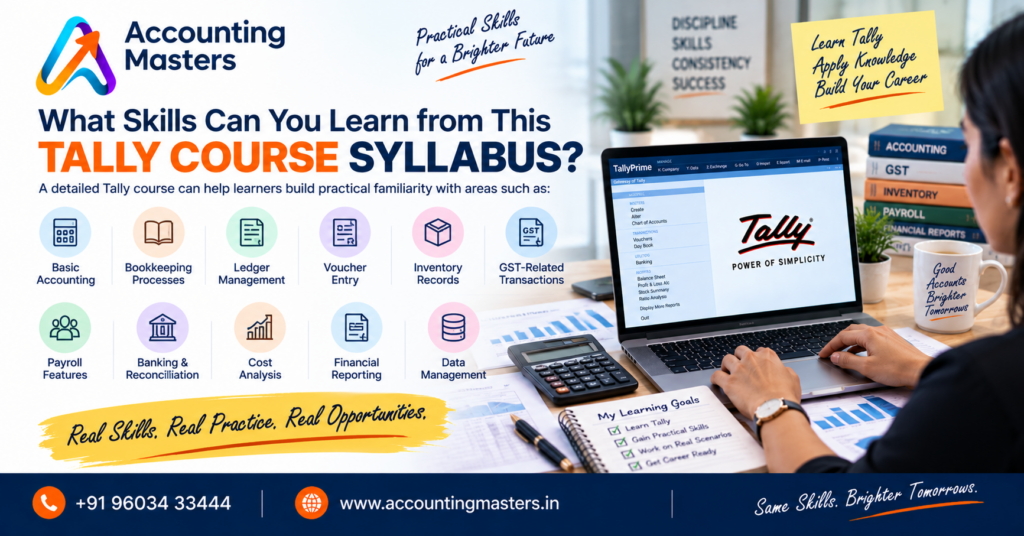
What Skills Can You Learn from This Tally Course Syllabus?
A detailed Tally course can help learners build practical familiarity with areas such as:
- Basic accounting
- Bookkeeping processes
- Ledger management
- Voucher entry
- Inventory records
- GST-related transactions
- Payroll features
- Banking and reconciliation
- Cost analysis
- Financial reporting
- Data management
The actual level of confidence developed depends greatly on how regularly a learner practises.
Who Can Benefit from Learning Tally?
Students
Students can use Tally training to gain exposure to practical accounting processes.
Commerce Graduates
Graduates can strengthen their understanding of accounting software alongside theoretical knowledge.
Freshers
Freshers can learn how common business transactions are recorded.
Aspiring Accountants
People interested in accounting roles can build familiarity with practical accounting workflows.
Small Business Owners
Business owners may benefit from understanding how financial and stock information is maintained.
Working Professionals
Professionals can improve their knowledge of accounting software features relevant to their work.
Why Hands-On Practice Is Important
Learning menus and options alone does not provide a complete understanding of accounting software.
A learner gains better clarity by working through realistic transactions.
For example:
A student can create a supplier ledger, record a credit purchase, make a payment and then review the impact of those entries in the ledger and financial reports.
This type of practice connects individual steps into one complete accounting process.
Regular exercises can help learners become more comfortable with:
- Transaction recording
- Voucher selection
- Ledger creation
- Error checking
- Report analysis
FAQs About the Tally Course Syllabus
The syllabus of Tally course at Accounting Masters covers accounting fundamentals, company and ledger creation, voucher entries, inventory management, GST, payroll, TDS and TCS, bank reconciliation, costing, data management and other practical TallyPrime features. The course also includes resume preparation, interview questions and job support.
Yes. The curriculum starts with manual accounting concepts and an introduction to Tally before progressing to more advanced features.
Yes. GST is included as a dedicated area of learning within the curriculum.
Yes. The syllabus includes inventory-related topics such as stock groups, stock items, units and stock management.
Yes. Payroll is included, covering employee and salary-related features.
Bank reconciliation helps compare accounting records with bank-related information and identify differences that require attention.
Yes. The syllabus also includes areas such as Bills of Material, Cost Centres, Job Costing, Budgets, Multicurrency, Scenarios and Data Management.
The Accounting Masters curriculum also includes resume preparation, interview questions and job-related support.
Conclusion
The Tally course syllabus at Accounting Masters covers a wide range of accounting and software-related topics through 23 modules.
Learners begin with fundamental accounting concepts and gradually move towards transaction entry, reporting, inventory, GST, payroll, banking and advanced Tally features.
A detailed syllabus can be useful because it allows students to understand the complete learning path before beginning their training.
However, completing modules alone is not enough. Regular practice with realistic transactions is what helps learners connect accounting knowledge with actual software usage.
For learners looking for structured training, understanding each module and practising consistently can make the learning process more meaningful.